I have been doing some autoformalization related to PDE and free boundary problems, see my GitHub repos bernoulli-parabolic-comparison, viscosity-solution-theory, parabolic-basic-theory, aleksandrov-differentiability, gmt-foundations. Please feel free to reach out if you want to discuss.
Click the abstract button to reveal the abstract. Click the figure buttons, if available, to reveal some inspiration.Preprints
-
arXivVariational properties of Perron's extremal solutions in the Bernoulli one-phase problemjoint with Farhan Abedin and Kerrek Stinson.
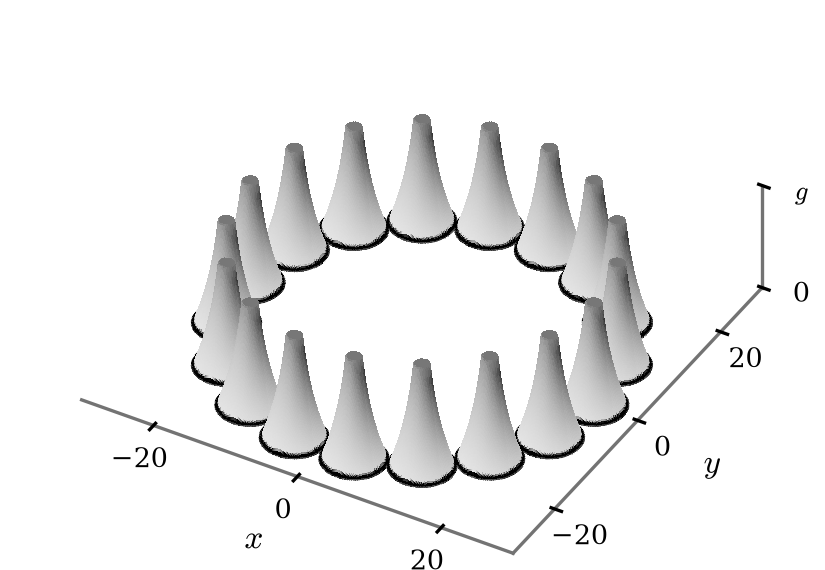
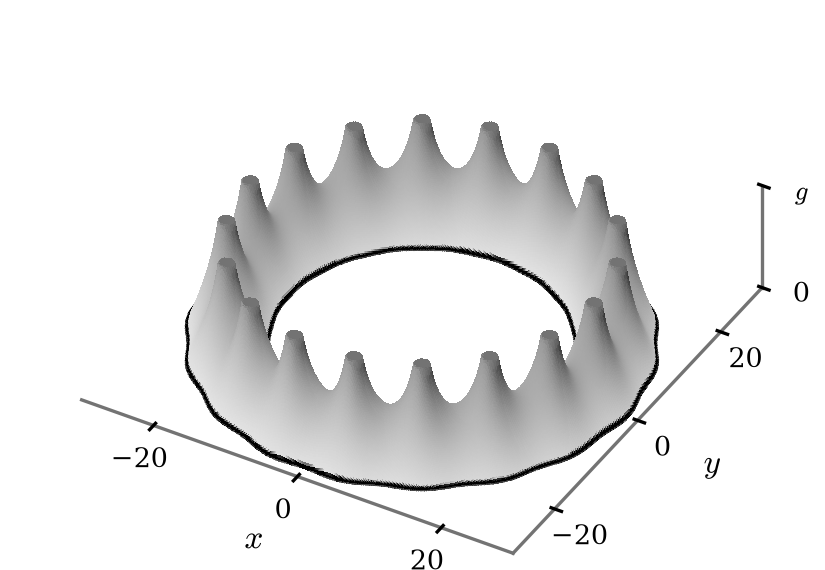
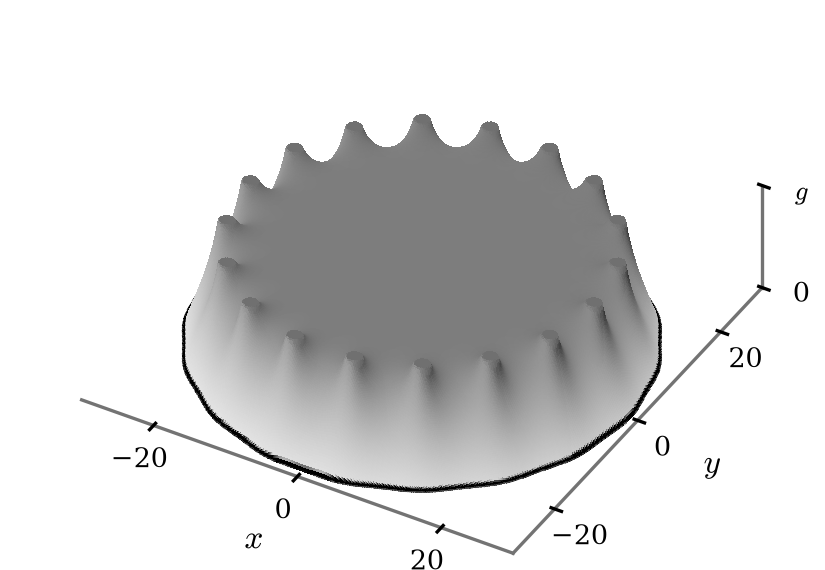 We study the Perron extremal solutions of the stationary one-phase Bernoulli problem. These solutions are important in several applications, but not much is known about the regularity of their free boundaries due to their non-variational construction. We show that, in fact, Perron extremal solutions retain some variational features; specifically, they are solutions in the sense of inner variations. We establish this property by showing that extremal solutions arise as infinite-time limits of monotone solutions of the parabolic Bernoulli problem. As a consequence, we are able to describe the structure of singularities for Perron extremal solutions in two dimensions: largest subsolutions have smooth free boundaries, while smallest supersolutions have free boundary points that are either smooth, or whose blow-up limits are two-plane wedges with equal slope.
-
arXivA domain decomposition method for the directional contact angle hysteresis interval on doubly periodic rough surfacesjoint with Zijie Lin and Braxton Osting.We study wetting on a doubly periodic rough surface in three dimensions. Although the liquid-vapor interface meets the solid at the local Young's angle, microscale roughness can cause the macroscopic apparent angle to differ substantially from this value. We formulate the directional contact angle hysteresis (CAH) interval in terms of apparent angles associated with pinned microscopic configurations. To approximate its receding and advancing endpoints, we evolve capillary mean curvature flow (CMCF) toward extremal stationary states. Computing these states is difficult because the pinning that produces hysteresis is generated at the scale of the roughness, whereas the apparent angle is only meaningful at the macroscopic scale, so a single uniform grid must resolve both. We therefore introduce a two-scale alternating (TSA) method based on a Schwarz decomposition: a Merriman-Bence-Osher (MBO) diffusion-generated scheme resolves the contact-line near region, while a linearized minimal-surface problem updates the far region. For an idealized reference iteration, we prove decay of an approximate interfacial energy. Numerical experiments on a representative doubly periodic surface show a strongly anisotropic CAH interval whose width varies by more than a factor of three with contact-line orientation and changes sharply near the diagonal directions. Because a stationary droplet must meet the solid at an apparent angle inside this interval, the computed anisotropy constrains which macroscopic wetted regions the surface can support; it is consistent with a square-like stationary droplet whose sides align with the diagonal directions.
-
arXivSolutions of the Bernoulli one-phase problem with a defectjoint with Inwon Kim.We study the far-field behavior of solutions of the one-phase Bernoulli free boundary problem in the exterior of a ball, and of entire solutions with a single compactly supported inhomogeneity of the free boundary condition, which we call a defect. For solutions which blow down to a half-plane solution (proper solutions) we establish an asymptotic expansion at infinity: in dimension $d \geq 3$ the free boundary height converges to a limit at rate $|x|^{2-d}$ with a capacity-type coefficient, while in dimension $d=2$ the expansion carries a logarithmic term. A significant novelty is that the expansions are quantitative and uniform over all the proper solutions.
-
arXiv SlidesThe pinning effect of dilute defectsjoint with Inwon Kim.
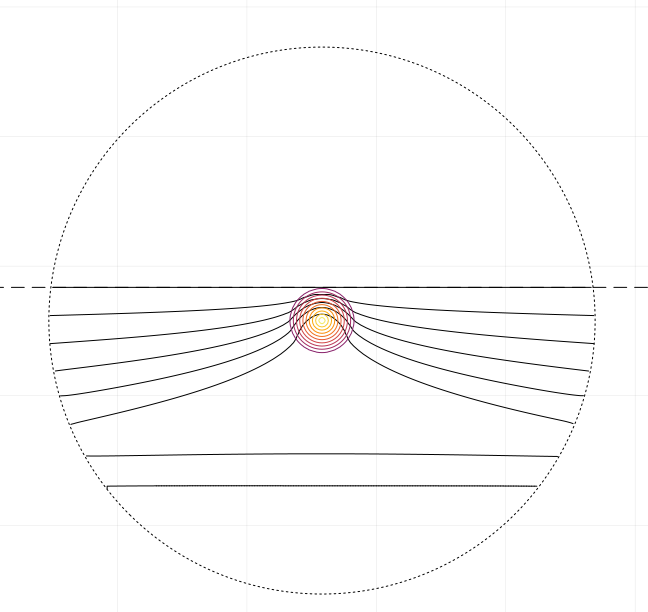
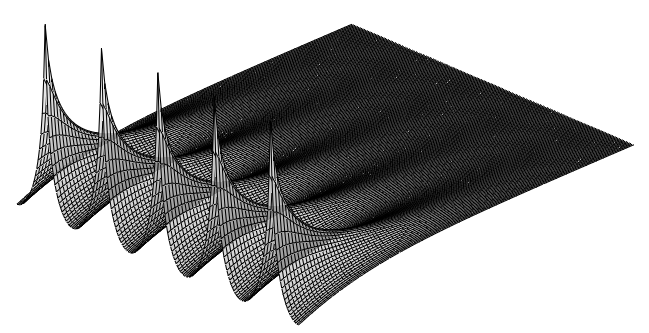 We consider the Bernoulli free boundary problem with "defects", inhomogeneities in the coefficients of compact support. When the defects are small and arrayed periodically there exist plane-like solutions with a range of large-scale slopes slightly different from the background field value. This is known as pinning. By studying the capacity-like pinning effect of a single defect in the Bernoulli free boundary problem, we can compute the asymptotic expansion of the interval of pinned slopes as the defect size goes to zero for lattice aligned normal directions. Our work is motivated by the issue of contact angle hysteresis in capillary contact lines.
-
arXivRate independent capillary motion on a narrow Wilhelmy platejoint with Carson Collins.We study a rate independent energetic model of the Wilhelmy plate experiment in capillarity. The evolution is driven by vertical motions of the plate. We show stability of energy solutions to the evolution, in the sense used in the rate-independent systems literature, as the ratio between container width and plate width goes to infinity. In particular, we show that the volume-constraint for the finite-ratio problem disappears in the limit. This leads to a volume-unconstrained Dirichlet-forced evolution, a setting where monotonicity, uniqueness, and contact line regularity properties have been established in previous literature. Our result is based on using comparison principle techniques for the prescribed mean curvature equation with capillary contact angle condition that characterizes the liquid surface at equilibrium. Through barrier arguments, we are able to develop asymptotics for the energy which give us control independent of the container-to-plate ratio.
-
arXiv SlidesRegularity of two-phase free boundary minimizers in periodic mediajoint with Farhan Abedin.We study the regularity of minimizers of a two-phase energy functional in periodic media. Our main result is a large scale Lipschitz estimate. We also establish improvement-of-flatness for non-degenerate minimizers, which is a key ingredient in the proof of the Lipschitz estimate. As a consequence, we obtain a Liouville property for entire non-degenerate minimizers.
-
arXiv SlidesMinimizing movements solutions for a monotone model of droplet motionjoint with Carson Collins.We study the uniqueness and regularity of minimizing movements solutions of a droplet model in the case of piecewise monotone forcing. We show that such solutions evolve uniquely on each interval of monotonicity, but branching non-uniqueness may occur where jumps and monotonicity changes coincide. This classification of minimizing movements solutions allows us to reduce the quasi-static evolution to a finite sequence of elliptic problems and establish uniform in time C^{1,1/2} spatial regularity of solutions.
-
arXiv SlidesMean curvature flow with positive random forcing in 2-dWe consider the forced mean curvature flow in 2-d, finite range of dependence and positive random forcing. We prove flatness and existence of effective speed for initially flat propagating fronts. This is the analogue, in random media, of a result of Caffarelli and Monneau. The main new tools are a large scale Lipschitz estimate for the arrival time function, and a quantitative uniqueness result which does not use uniform local regularity.
-
arXivRecovering coercivity for the G-equation in general random mediaThe G-equation is a popular model for premixed turbulent combustion. Mathematically it has attracted a lot of interest in part because it is a simple example of a Hamilton-Jacobi equation which is only coercive "on average". This paper shows that, after an almost surely finite waiting time, coercivity is recovered for the G-equation in a small mean, incompressible, space-time stationary ergodic velocity field. The argument follows ideas from recent work of Burago, Ivanov and Novikov, while significantly weakening the assumption on the velocity field. The waiting time is explicitly characterized in terms of the space-time means of the velocity field and so mixing estimates on the waiting time can easily be derived. Examples are provided.
Publications
-
arXiv Journal SlidesOn the geometry of rate-independent droplet evolutionCalculus of Variations and Partial Differential Equations, Volume 65, Issue 10, Paper No. 265, 2026
joint with Inwon Kim and Norbert Požár.We introduce a toy model for rate-independent droplet motion on a surface with contact angle hysteresis based on the one-phase Bernoulli free boundary problem. We consider a notion of energy solutions and show existence by a minimizing movement scheme. The main result of the paper is on the PDE conditions satisfied by general energy solutions: we show that the solutions satisfy the dynamic contact angle condition H^{d-1}-a.e. along the contact line at every time. -
arXiv Journal SlidesHomogenization of a vertical oscillating Neumann conditionArchive for Rational Mechanics and Analysis, Volume 250, Issue 3, Paper No. 29, 2026
joint with Zhonggan Huang.We homogenize the Laplace and heat equations with the Neumann data oscillating in the "vertical" u-variable. These are simplified models for interface motion in heterogeneous media, particularly capillary contact lines. The homogenization limit reveals a pinning effect at zero tangential slope, leading to a novel singularly anisotropic pinned Neumann condition. The singular pinning creates an unconstrained contact set, generalizing the contact set in the classical thin obstacle problem. We establish a comparison principle for the heat equation with this new type of boundary condition. The comparison principle enables a proof of homogenization via the method of half-relaxed limits from viscosity solution theory. Our work also demonstrates, for the first time in a PDE problem in multiple dimensions, the emergence of rate-independent pinning from gradient flows with wiggly energies. Prior limit theorems of this type, in rate-independent contexts, were limited to ODEs and PDEs in one dimension. -
arXiv JournalRegularity theory of a gradient degenerate Neumann problemJournal de Mathématiques Pures et Appliquées, Volume 209, 103863, 2026
joint with Zhonggan Huang.We study the regularity and comparison principle for a gradient degenerate Neumann problem. The problem is a generalization of the Signorini or thin obstacle problem which appears in the study of certain singular anisotropic free boundary problems arising from homogenization. In scaling terms, the problem is critical since the gradient degeneracy and the Neumann PDE operator are of the same order. We show the (optimal) C^{1,1/2} regularity in dimension d=2 and we show the same regularity result in d>=3 conditional on the assumption that the degenerate values of the solution do not accumulate. We also prove a comparison principle characterizing minimal supersolutions, which we believe will have applications to homogenization and other related scaling limits. -
arXiv JournalCompactness for GSBVp via concentration-compactnessProceedings of the AMS, Volume 154, No. 7, pp. 2965-2981, 2026
joint with Kerrek Stinson.Motivated by variational models for fracture, we provide a new proof of compactness for GSBVp functions without a priori bounds on the function itself. Our proof is based on the classical idea of concentration- compactness, making it transparent in strategy and simple in implementation. Further, so far as we are aware, this is the first time the connection to concentration-compactness has been made explicit for problems in fracture mechanics. -
arXiv Journal SlidesAn obstacle approach to rate-independent droplet evolutionForum of Mathematics, Sigma, Volume 14, 2026, e38
joint with Inwon Kim and Norbert Požár.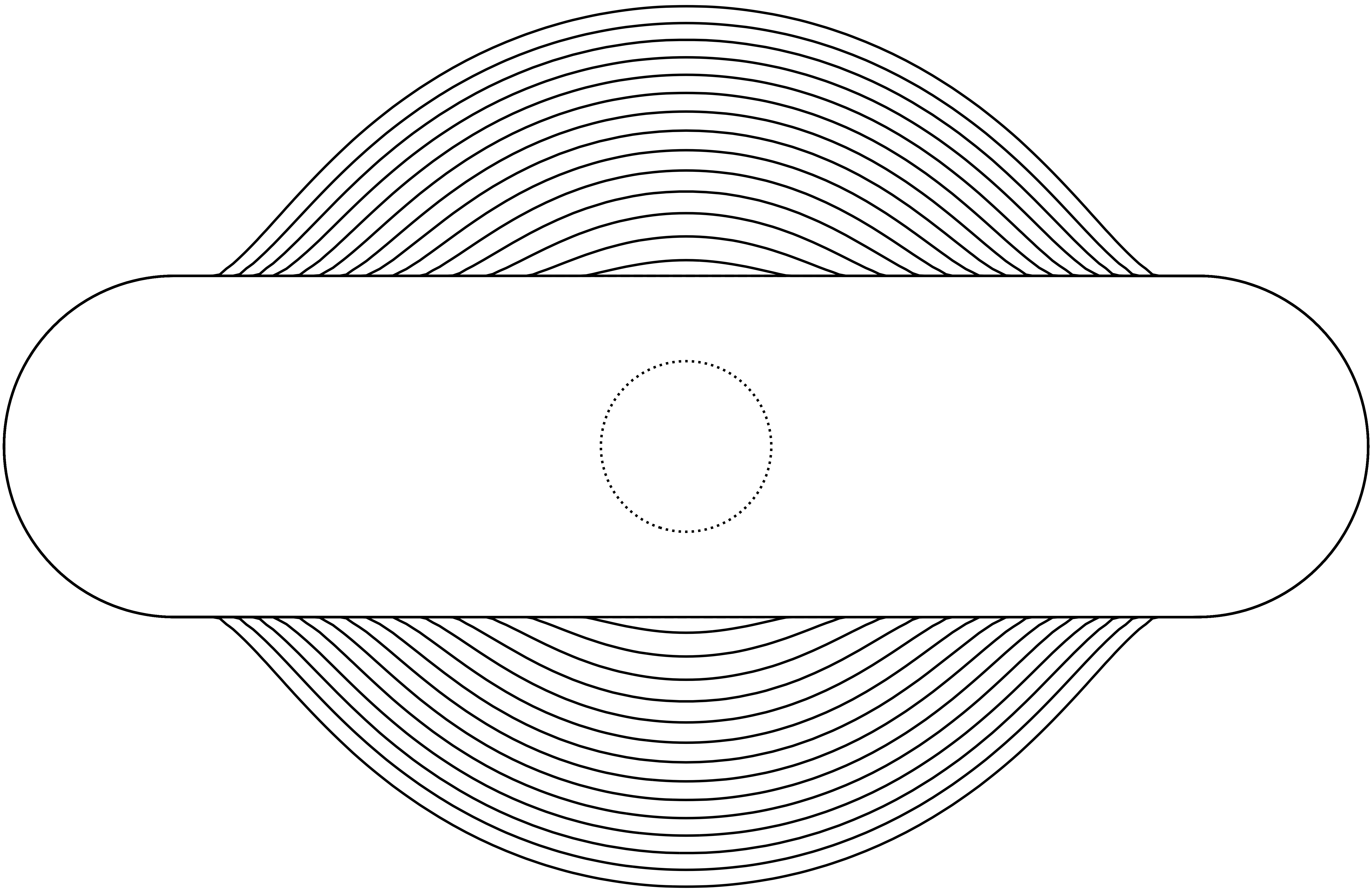
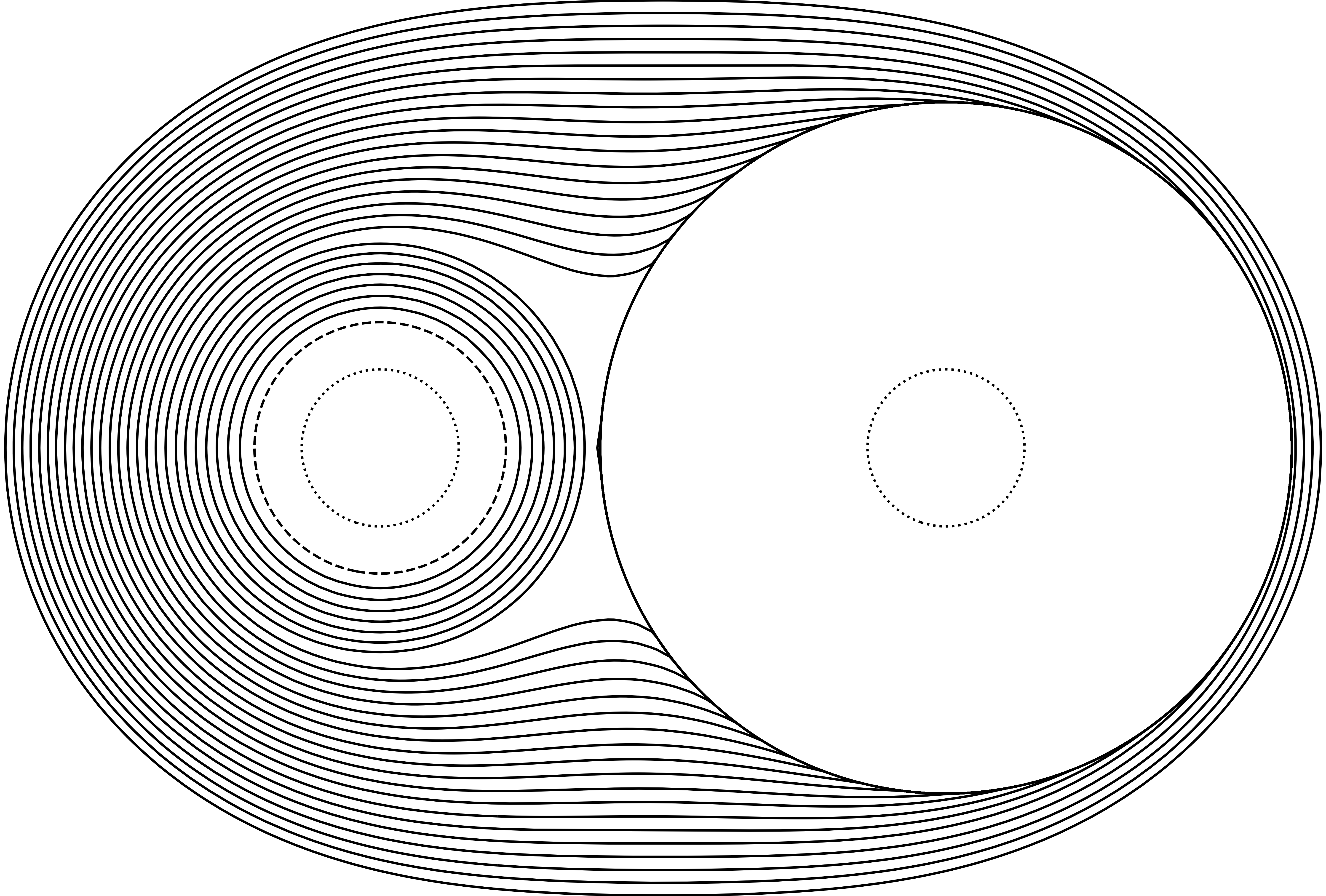 We consider a toy model of rate independent droplet motion on a surface with contact angle hysteresis based on the one-phase Bernoulli free boundary problem. We introduce a notion of solutions based on an obstacle problem. These solutions jump "as late and as little as possible", a physically natural property that energy solutions do not satisfy. When the initial data is star-shaped, we show that obstacle solutions are uniquely characterized by satisfying the local stability and dynamic slope conditions. This is proved via a novel comparison principle, which is one of the main new technical results of the paper. In this setting we can also show the (almost) optimal C^{1,1/2}-spatial regularity of the contact line. This regularity result explains the asymptotic profile of the contact line as it de-pins via tangential motion similar to de-lamination. Finally we apply our comparison principle to show the convergence of minimizing movements schemes to the same obstacle solution, again in the star-shaped setting.
-
arXiv JournalGlobal well-posedness of a nonlinear Fokker-Planck type model of grain growthDiscrete and Continuous Dynamical Systems, 2025
joint with Batuhan Bayir and Yekaterina Epshteyn.Most technologically useful materials spanning multiple length scales are polycrystalline. Polycrystalline microstructures are composed of a myriad of small crystals or grains with different lattice orientations which are separated by interfaces or grain boundaries. The changes in the grain and grain boundary structure of polycrystals highly influence the materials properties including, but not limited to, electrical, mechanical, and thermal. Thus, an understanding of how microstructures evolve is essential for the engineering of new materials. In this paper, we consider a recently introduced nonlinear Fokker-Planck-type system and establish a global well-posedness result for it. Such systems under specific energy laws emerge in the modeling of the grain boundary dynamics in polycrystals. -
arXiv Journal SlidesOn convex comparison for exterior Bernoulli problems with discontinuous anisotropyInterfaces and Free Boundaries, Vol. 27, No. 3, pp. 459-468, 2024
joint with Norbert Požár.We give a new proof of a convex comparison principle for exterior Bernoulli free boundary problems with discontinuous anisotropy. -
arXiv JournalThe sharp interface limit of an Ising GameESAIM: Control, Optimisation and Calculus of Variations, Volume 30, article 35, 2024
joint with Inwon Kim and Aaron Zeff Palmer.The Ising model of statistical physics has served as a keystone example of phase transitions, thermodynamic limits, scaling laws, and many other phenomena and mathematical methods. We introduce and explore an Ising game, a variant of the Ising model that features competing agents influencing the behavior of the spins. With long-range interactions, we consider a mean-field limit resulting in a nonlocal potential game at the mesoscopic scale. This game exhibits a phase transition and multiple constant Nash-equilibria in the supercritical regime. Our analysis focuses on a sharp interface limit for which potential minimizing solutions to the Ising game concentrate on two of the constant Nash-equilibria. We show that the mesoscopic problem can be recast as a mixed local/nonlocal space-time Allen-Cahn type minimization problem. We prove, using a Gamma-convergence argument, that the limiting interface minimizes a space-time anisotropic perimeter type energy functional. This macroscopic scale problem could also be viewed as a problem of optimal control of interface motion. Sharp interface limits of Allen-Cahn type functionals have been well studied. We build on that literature with new techniques to handle a mixture of local derivative terms and nonlocal interactions. The boundary conditions imposed by the game theoretic considerations also appear as novel terms and require special treatment. -
arXiv Journal SlidesQuantitative homogenization of principal Dirichlet eigenvalue shape optimizersCommunications on Pure and Applied Mathematics, Vol 77, Issue 6, pp. 3026-3079, 2024
We apply new results on free boundary regularity of one-phase almost minimizers in periodic media to obtain a quantitative convergence rate for the shape optimizers of the first Dirichlet eigenvalue in periodic homogenization. We obtain a linear (with logarithmic factors) convergence rate for the optimizing eigenvalue. Large scale Lipschitz free boundary regularity of almost minimizers is used to apply the optimal L2 homogenization theory in Lipschitz domains of Kenig, Lin and Shen. A key idea, to deal with the hard constraint on the volume, is a combination of a large scale almost dilation invariance with a selection principle argument. -
arXiv JournalQuantitative convergence of the "bulk" free boundary in an oscillatory obstacle problemInterfaces and Free Boundaries, Vol. 26, No. 1, pp 31-44, 2023
joint with Farhan Abedin.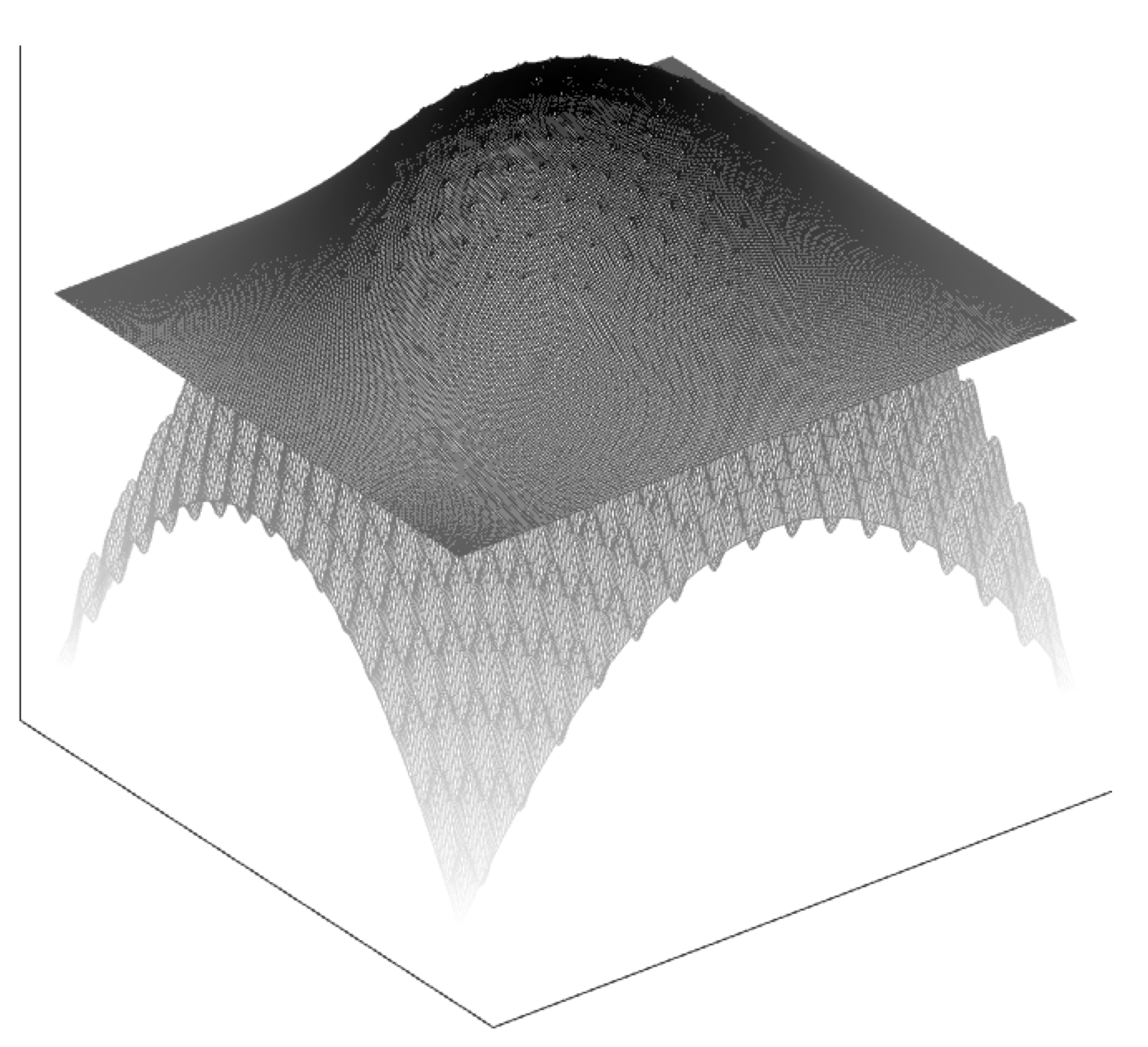 We consider an oscillatory obstacle problem where the coincidence set and free boundary are also highly oscillatory. We establish a rate of convergence for a regularized notion of free boundary to the free boundary of a corresponding classical obstacle problem, assuming the latter is regular. The convergence rate is linear in the minimal length scale determined by the fine properties of a corrector function.
-
arXiv Journal SlidesLarge scale regularity of almost minimizers of the one-phase problem in periodic mediaArs Inveniendi Analytica, Paper No. 2, 41 pp, 2023
We prove that minimizers and almost minimizers of one-phase free boundary energy functionals in periodic media satisfy large scale (1) Lipschitz estimates (2) free boundary flat implies Lipschitz estimates. The proofs are based on techniques introduced by De Silva and Savin for almost minimizers in homogeneous media. -
arXiv JournalThe occurrence of surface tension gradient discontinuities and zero mobility for Allen-Cahn and curvature flows in periodic mediaInterfaces and Free Boundaries, Vol 25, No 4, pp 567-631, 2023
joint with Peter Morfe.We construct several examples related to the scaling limits of energy minimizers and gradient flows of surface energy functionals in heterogeneous media. These include both sharp and diffuse interface models. The focus is on two separate but related issues, the regularity of effective surface tensions and the occurrence of zero mobility in the associated gradient flows. On regularity we build on the theory of Goldman, Chambolle and Novaga to show that gradient discontinuities in the surface tension are generic for sharp interface models. In the diffuse interface case we only show that the laminations by plane-like solutions satisfying the strong Birkhoff property generically are not foliations and do have gaps. On mobility we construct examples in both the sharp and diffuse interface case where the homogenization scaling limit of the L2 gradient flow is trivial, i.e. there is pinning at every direction. In the sharp interface case, these are related to examples previously constructed by Novaga and Valdinoci for forced mean curvature flow. -
arXiv JournalAn example of failure of stochastic homogenization for viscous Hamilton-Jacobi equations without convexityJournal of Differential Equations, 280: 464-476, 2021
joint with Jean-Baptiste Fermanian and Bruno Ziliotto.We give an example of the failure of homogenization for a viscous Hamilton-Jacobi equation with non-convex Hamiltonian. -
arXiv Journal SlidesLimit shapes of local minimizers for the Alt-Caffarelli functional in inhomogeneous mediaArchive for Rational Mechanics and Analysis, 240: 1255-1322, 2021
This paper considers the Alt-Caffarelli free boundary problem in a periodic medium. This is a convenient model for several interesting phenomena appearing in the study of contact lines on rough surfaces, pinning, hysteresis and the formation of facets. We show the existence of an interval of effective pinned slopes at each direction e in S^{d-1}. In d=2 we characterize the regularity properties of the pinning interval in terms of the normal direction, including possible discontinuities at rational directions. These results require a careful study of the families of plane-like solutions available with a given slope. Using the same techniques we also obtain strong, in some cases optimal, bounds on the class of limit shapes of local minimizers in d=2, and preliminary results in d>=3. -
arXiv JournalContinuity properties for divergence form boundary data homogenization problemsAnalysis and PDE, 12(8): 1963-2002, 2019
joint with Yuming Paul Zhang.We study the continuity/discontinuity of the effective boundary condition for periodic homogenization of oscillating Dirichlet data for nonlinear divergence form equations and linear systems. For linear systems we show continuity, for nonlinear equations we give an example of discontinuity. -
arXiv Journal SlidesA free boundary problem with facetsArchive for Rational Mechanics and Analysis, 232(1): 389-435, 2019
joint with Charles Smart.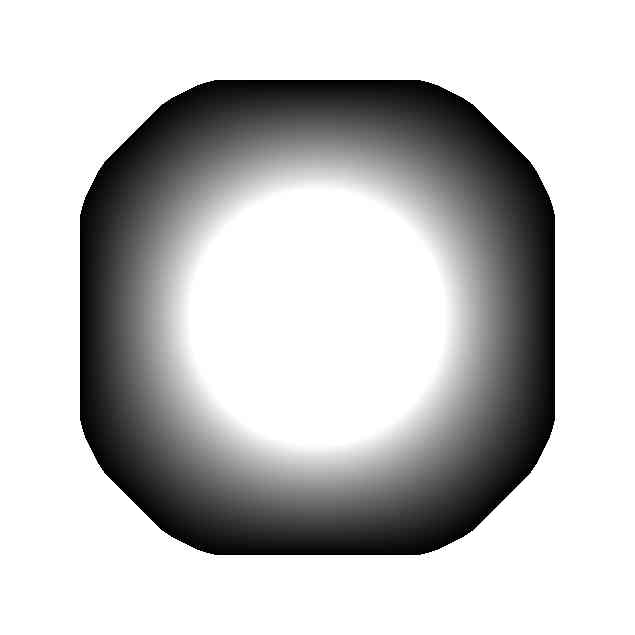
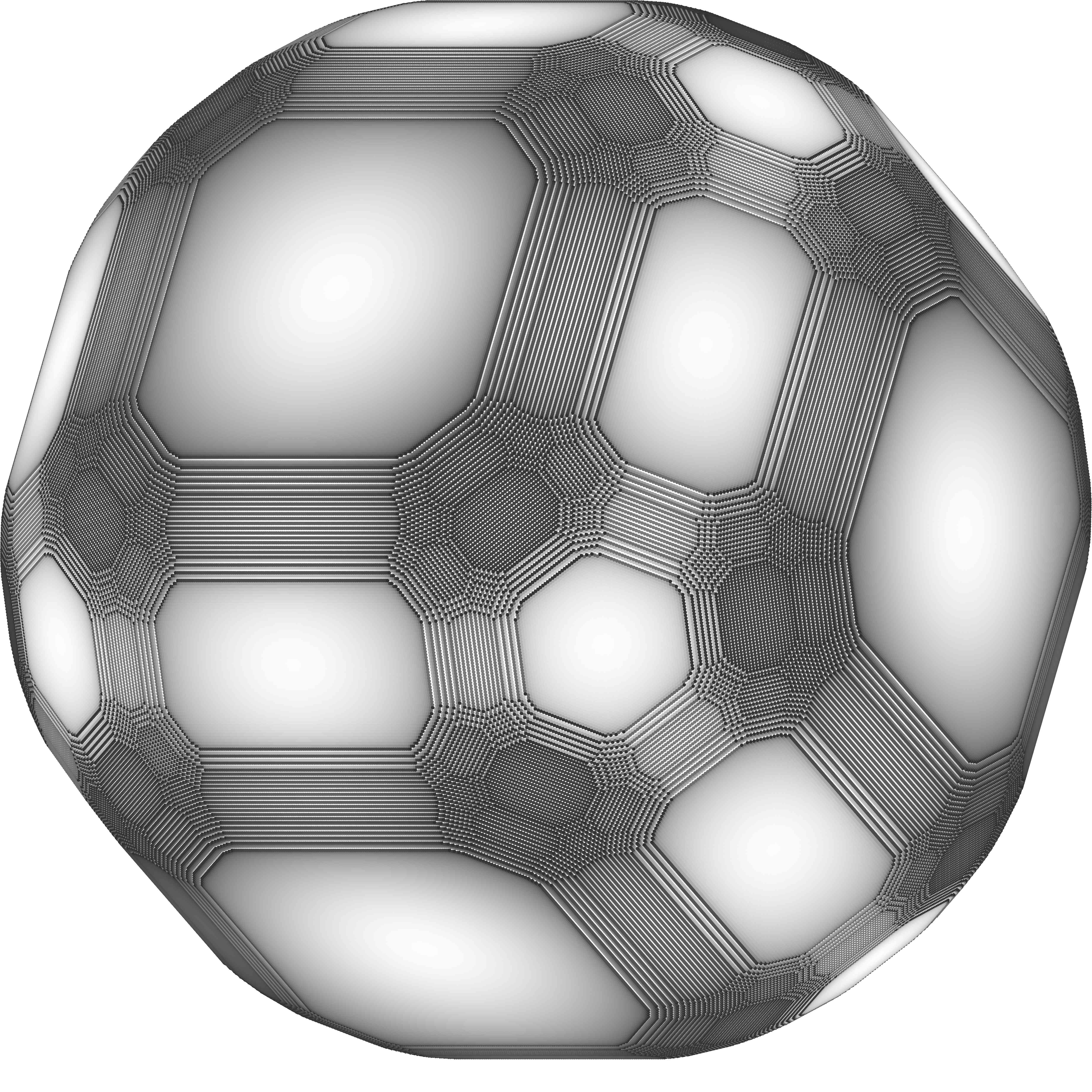
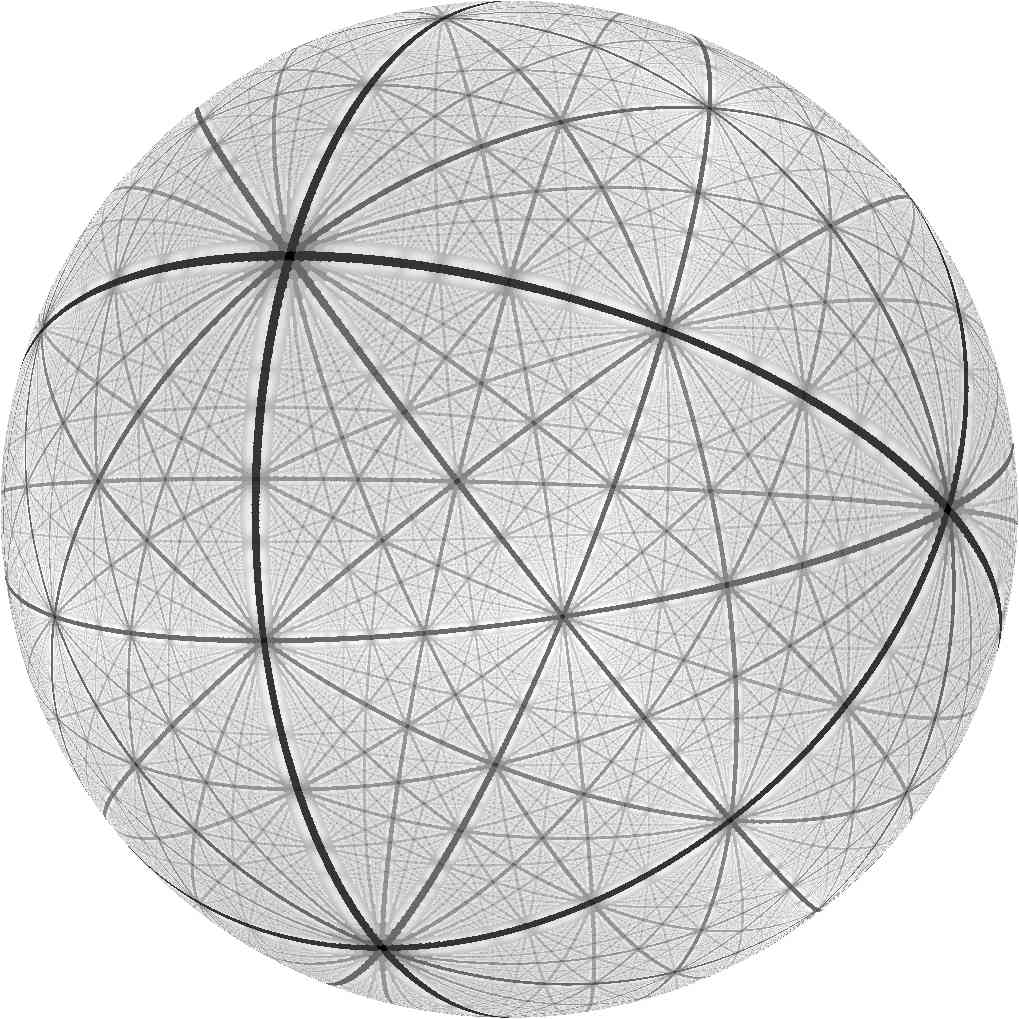 We study a free boundary problem on the lattice whose scaling limit is a harmonic free boundary problem with a discontinuous Hamiltonian. We find an explicit formula for the Hamiltonian, prove the solutions are unique, and prove that the limiting free boundary has a facets in every rational direction. Our choice of problem presents difficulties that require the development of a new uniqueness proof for certain free boundary problems. The problem is motivated by physical experiments involving liquid drops on patterned solid surfaces.
-
arXiv JournalStability of Serrin's Problem and Dynamic Stability of a Model for Contact Angle MotionSIAM Journal on Mathematical Analysis, 50(3): 3303-3326, 2018
We study the quantitative stability of Serrin's symmetry problem and its connection with a dynamic model for contact angle motion of quasi-static capillary drops. We prove a new stability result which is both linear and depends only on a weak norm. This improvement is particularly important to us since the L2(partial Omega) norm squared of |Du|^2-1 is exactly the energy dissipation rate of the associated dynamic model. Combining the energy estimate for the dynamic model with the new stability result for the equilibrium problem yields an exponential rate of convergence to the steady state for regular solutions of the contact angle motion problem. As far as we are aware this is one of the first applications of a stability estimate for a geometric minimization problem to show dynamic stability of an associated gradient flow. -
arXiv JournalLiquid Drops on a Rough SurfaceCommunications on Pure and Applied Mathematics, 71(12): 2429-2499, 2018
joint with Inwon Kim.We consider a liquid drop sitting on a rough solid surface at equilibrium, a volume constrained minimizer of the total interfacial energy. The large-scale shape of such a drop strongly depends on the micro-structure of the solid surface. Surface roughness enhances hydrophilicity and hydrophobicity properties of the surface, altering the equilibrium contact angle between the drop and the surface. Our goal is to understand the shape of the drop with fixed small scale roughness. To achieve this, we develop a quantitative description of the drop and its contact line in the context of periodic homogenization theory, building on the qualitative theory of Alberti and DeSimone. -
arXiv JournalHomogenization and Non-Homogenization of certain Non-Convex Hamilton-Jacobi EquationsJournal de Mathématiques Pures et Appliquées, 108(5): 751-782, 2017
joint with Panagiotis Souganidis.We continue the study of the homogenization of coercive non-convex Hamilton-Jacobi equations in random media identifying two general classes of Hamiltonians with very distinct behavior. For the first class there is no homogenization in a particular environment while for the second homogenization takes place in environments with finite range dependence. Motivated by the recent counter-example of Ziliotto, who constructed a coercive but non-convex Hamilton-Jacobi equation with stationary ergodic random potential field for which homogenization does not hold, we show that same happens for coercive Hamiltonians which have a strict saddle-point, a very local property. We also identify, based on the recent work of Armstrong and Cardaliaguet on the homogenization of positively homogeneous random Hamiltonians in environments with finite range dependence, a new general class Hamiltonians, namely equations with uniformly strictly star-shaped sub-level sets, which homogenize. -
arXiv JournalContinuity and Discontinuity of the Boundary Layer TailAnnales de l'École Normale Supérieure, 50(4): 1017-1064, 2017
joint with Inwon Kim.We investigate the continuity properties of the homogenized boundary data \bar{g} for oscillating Dirichlet boundary data problems. We show that, for a generic non-rotation-invariant operator and boundary data, \bar{g} is discontinuous at every rational direction. In particular this implies that the continuity condition of Choi and Kim is essentially sharp. On the other hand, when this condition holds, we show a Holder modulus of continuity for \bar{g}. When the operator is linear we show that \bar{g} is Holder-1/d up to a logarithmic factor. The proofs are based on a new geometric observation on the limiting behavior of \bar{g} at rational directions, reducing to a class of two dimensional problems for projections of the homogenized operator. -
arXiv JournalQuantitative Homogenization of Elliptic PDE with Random Oscillatory Boundary DataJournal de Mathématiques Pures et Appliquées, 103(4): 958-1002, 2015
joint with Inwon Kim and Panagiotis Souganidis.We study the averaging behavior of nonlinear uniformly elliptic partial differential equations with random Dirichlet or Neumann boundary data oscillating on a small scale. Under conditions on the operator, the data and the random media leading to concentration of measure, we prove an almost sure and local uniform homogenization result with a rate of convergence in probability. -
arXiv JournalAn L1 Penalty Method for General Obstacle ProblemsSIAM Journal on Applied Mathematics, 75(4): 1424-1444, 2015
joint with Giang Tran and Hayden Schaeffer and Stanley Osher.We construct an efficient numerical scheme for solving obstacle problems in divergence form. The numerical method is based on a reformulation of the obstacle in terms of an L1-like penalty on the variational problem. The reformulation is an exact regularizer in the sense that for large (but finite) penalty parameter, we recover the exact solution. Our formulation is applied to classical elliptic obstacle problems as well as some related free boundary problems, for example the two-phase membrane problem and the Hele-Shaw model. One advantage of the proposed method is that the free boundary inherent in the obstacle problem arises naturally in our energy minimization without any need for problem specific or complicated discretization. In addition, our scheme also works for nonlinear variational inequalities arising from convex minimization problems. -
arXiv JournalHomogenization of the Oscillating Dirichlet Boundary Condition in General DomainsJournal de Mathématiques Pures et Appliquées, 101(5): 599-622, 2014
We prove the homogenization of the Dirichlet problem for fully nonlinear elliptic operators with periodic oscillation in the operator and of the boundary condition for a general class of smooth bounded domains. This extends the previous results of Barles and Mironescu in half spaces. We show that homogenization holds despite a possible lack of continuity in the homogenized boundary data. The proof is based on a comparison principle with partial Dirichlet boundary data which is of independent interest. -
arXiv JournalDynamic Stability of Equilibrium Capillary DropsArchive for Rational Mechanics and Analysis, 211(3): 819-878, 2014
joint with Inwon Kim.We investigate a model for contact angle motion of quasi-static capillary drops resting on a horizontal plane. We prove global in time existence and long time behavior (convergence to equilibrium) in a class of star-shaped initial data for which we show that topological changes of drops can be ruled out for all times. Our result applies to any drop which is initially star-shaped with respect to a small ball inside the drop, given that the volume of the drop is sufficiently large. For the analysis, we combine geometric arguments based on the moving-plane type method with energy dissipation methods based on the formal gradient flow structure of the problem.